As a work-from-home mother of two, I am fortunate enough to get a ton of face time with my girls. However, when my oldest daughter was old enough to go to preschool, I was torn.

On the one hand, that’s four to eight hours every day that she’s someone else’s problem. On the other hand, sending my baby into the care of another person went against every one of my maternal instincts.

When finally let go and enrolled her into preschool, I gained a whole new appreciation for the profession.

Having two kids is a full-time job—but what if your actual full-time job was to have a whole classroom full of kids, all day long? Honestly, choosing to do this is something I can’t imagine. That’s why I have so much adoration and respect for preschool teachers.

Seriously! These people are saints. They make their jobs look easy. However, us parents know that being a preschool teacher is more like herding cats that are chasing mice who are sniffing for cheese — it is not a task for the faint of heart.

There are many, many reasons why I’m thankful for my daughter’s preschool teachers. Oh, how I love you. Shall I list the ways?

Teachers Educate & Entertain

Preschool has changed in recent decades. A lot. When I was in preschool many moons ago, the emphasis was on socializing with other kids, finger-painting and nap time. Now, with the multitude of standardized tests and high expectations for our kids once they enter elementary school, preschool is a lot more academic than it used to be.

By the time they leave kindergarten, our kids are expected to read basic, consonant-vowel-consonant words, know the sounds of each letter and be able to write the alphabet. That means they better leave preschool ready to get learning!

There’s way more pressure on preschool teachers than ever to not only keep our kids entertained, but also to educate them at the same time. Luckily, there are a ton of really great resources for fun activities that make it easy to find new ways to teach all kids.

Teachers See a Different Side of Our Kids

Let’s keep this between you and me, but sometimes, my daughter sucks. Sometimes, I don’t even want to be around her and I made her. I guess that’s because she’s not afraid to show me her dark side.

Though I am proud to be raising an independent and strong-willed child, sometimes, when she looks me in the eye, I can tell that she’s asking me, “Do you have the guts to take me on?” I hide my fear, tilt up my chin and let my eyes tell her, “Yes… yes, I do.”

Her teacher, on the other hand, gets to see her at her best. Even though she was the baby of the group when she entered preschool, her progress has been phenomenal. With her teacher, she’s agreeable, polite and picks up her toys. With other kids, she’s cooperative, kind and considerate.

I’m so grateful that her teacher relays to me how lovely my daughter is, even if I don’t always see that side of her.

Teachers Connect with Our Kids

Relatedly, preschool teachers have an awesome ability to connect with our kids. That’s probably because they’re not us. Because of that connection, they can educate and teach children the real skills they will need as they learn and grow.

Whereas I feel like my primary job at this point is to teach my daughter how not to be a jerk, her preschool teacher is teaching her how to count, what the days of the week are, color names and a million other practical things, every day.

I was completely taken aback recently when my daughter came home from school and just casually counted to ten in Spanish followed with an “Adios, amigo!” Knowing full well I haven’t taught her a word of Spanish personally, it’s just another of the countless reasons to be so grateful for her teachers.

Teachers Have the Patience of Saints

I’m not going to lie—I have very little patience. After dealing with work all day, breastfeeding my infant daughter and shuffling my eldest to and from preschool, I’m spent.

By the time my husband gets home around 6, there’s not much patience left—for anyone.

Preschool teachers seem to have a well of patience they draw on during times of great stress, when half the classroom of kids are crying and the other half is breaking into the finger paints. I’m not sure how they do it, but I will say, I am impressed. I wish they could bottle up that patience and sell it as I would be first in line to purchase a case.

Preschool Teachers Are Incredibly Organized

Personally, I find that having a system of organization not only saves time, but it also reduces my stress and saves my sanity. If I didn’t have a system in place, I wouldn’t get anything done.

Being a preschool teacher is an unpredictable job. If you’re not prepared for any and every potential pitfall, your whole classroom structure could crumble into chaos. For this reason, having an organized classroom is essential—not just for preschool teachers, but really for all educators.

My daughter’s teacher is impressive. Not only is her classroom perfectly organized, with a designated place for every item, but she also has an inspiring system of folders to keep track of daily tasks, educational goals and student worksheets and activities. I wish she would organize my life.

Teachers Have to Deal With Me (the Parent)

Lest we forget that in addition to dealing with tiny tots all day, these preschool teachers need to deal with parents, too!

Every day when I pick my daughter up from school her teacher is ready and waiting to give me the rundown on how her day was, what she ate, what she didn’t eat, if she napped—all while simultaneously wrangling all of the other students she’s still caring for. I know I could never do this job and it’s always impressive to witness first hand.

Preschool Teachers Are Basically the Best!

So there you have it. Preschool teachers are amazing. They put up with our kids. They put up with us parents. Amazingly, they do it all with smiling faces. They deserve so much credit for their patience and the role they play in shaping the minds of our children.

Next time you meet a preschool teacher—or any teacher really—give them a high-five and tell them how thankful you are for all they do.

Jennifer Landis is a mom, wife, freelance writer, and blogger. She enjoys long naps on the couch, sneaking spoonfuls of peanut butter when her kid's not looking, and binge watching Doctor Who while her kid's asleep.  She really does like her kid, though, she promises. Find her on Twitter @JenniferELandis.

In light of these parents getting exposed for paying their kids way into college, I feel as though we should discuss 2019 parenting.

First off, we know this stuff happens everywhere. People paying their kids way into things. I just think it’s hilarious that Auntie Becky got caught thinking she’s above the rules of decency and good parenting. Jesse and the Rippers are going to be so disappointed.

In my opinion, our generation of parenting is interesting and maybe we should stop to reflect for a moment.

A few decades ago: No seat belts, no baby gates, latch key kids.. You know the generation that always shrugs and says “We didn’t know.”

Well now we know.

We know how to keep our kids safe. We have great tools to do that.

Yet, just like everything else in humanity, we oversteer the ship.

This generation of parenting thinks that part of their job description is to protect their kids from all pain and failure.

That is indeed the wrong job description.

You are the coach, not their bodyguard.

When a boy from the neighborhood called me a “fat f*cking bag of fart cheese” while playing capture the flag one afternoon. It’s good my parents weren’t there to step in and solve that situation for me.

The stinging on my face with embarrassment. The lack of words to say. The twenty minutes of replaying that moment in my head while sulking on the swing. Coming up with a long lines of witty come backs.

Learning to stand up for myself did not come from my parents standing up for me. It came from the fact that they empowered me and that I did it for myself.

Every time you want to come into a situation and throw haymakers for your kid. Stop and take a breath. Say out loud, “us as parents are the problem.”

Your kid is not yours to control. It is not your job to stop them from ever feeling any pain or rejection.

YOU ARE THE COACH.

Get off the court. Get onto the sidelines and start clapping.

Call time out and have a conversation. Give advice. Talk about a plan.

Nope. Don’t go out onto the court. You can’t lift up your teenage kid to dunk the ball in the middle of the game.

Back to the bench for you. Start clapping.

You are the coach.

You are your kids biggest support! You make game plans. You watch film. You practice with them. You cheer for them louder than anyone in the stands.

But you don’t belong on the court.

If your kid bricks a lay up. You have to watch.

Then start clapping again. Build them up so they can see another opportunity will come.

Get off the court or you will get a technical foul.

My Dad got a lot of technical fouls while I was growing up, but good thing they were actual on the basketball court. Haha. Hi Dad!

You have to be your child’s biggest support, but know where to draw the line.

Don’t go onto the court.

You don’t belong there.

Getting rejected is powerful. Failing is powerful. Even though it’s hard to watch, you can’t steal those moments from your child’s development as a person.

You have to coach them on how to deal with it. How to move on. How to regroup. How to not let those moments crush you or define you.  How to be brave enough to ask for help.

The worst thing you can do is give your kid something they didn’t earn. They will never grow up to be the humans you hoped they’d be.

We are the generation of parents who thinks their job is to do things for their kids.

Please stop doing things for your kids.

Please stop setting up their environment so precisely they don’t get to experience the world.

Life is painful. Life is messy. Life sucks at times.

Watching your kid be in pain can be hard. But that’s where you get all the life lessons. That is where you learn to be resilient. That’s how you learn that this too shall pass.

Don’t worry, you will be right there to cheer for them when they stand back up and brush themselves off.

You will be the loudest person cheering for them.

But get off the court.

Love,

Britt

Britt Burbank is a Beach bum, Mom, Wife, Sister, Friend, Coach, Bikram Yoga Instructor, Special needs advocate, Library enthusiast,  Mom blogger. Britt lives in a barn on Cape Cod with her husband, two toddlers, and stinky black lab. You can read more of her adventures at You're Somebody's MOTHER.

Photo: Shutterstock

Raising Generation Z teens has some interesting moments. For instance, I discovered that Netflix has an interesting effect on my teens—it turns them into sloths who only move when absolutely necessary. They love nothing more than plunking themselves in front of the TV binge-watching their favorite shows from start to finish.

Watching them made me nostalgic—and a little jealous.

I remember how it was when I was their age. I had to patiently wait for 24 hours to watch the next episode of my best shows. It was more dreadful if said shows came on weekly because then I had to endure the torture of waiting a whole seven days to see what happened next. Talk about suspense!

Living in a Bespoke World

Things are totally different now thanks to smart devices and the internet. Nowadays kids everywhere reap the benefits of living in a curated world where they can watch or read what they want when they want it.

It is a wonderful life but I realized that it has a darker side, too.

For one thing, more parents are complaining that their kids are choosing to stay tethered to their devices instead of doing something imaginative or creative. Teen internet addiction is a real thing, fed partly by having an enticing array of curated items—music, movies, games, etc.—delivered right to our kids’ screens.

While internet addiction is serious, I’m more worried about the death of imagination and creativity that my kids display. Even the younger ones rarely play pretend games anymore. They don’t spend hours wondering what their favorite TV characters will get up to next because they can watch whole seasons of those TV shows in days. Having what they like constantly fed to them on demand does nothing to spark their imagination.

Additionally, living in a curated world means that they miss out on the natural randomness and serendipity that can inspire innovation. They are only likely to be exposed to the kind of music they like or get suggestions for more books from their favorite author or genre. There’s no space for them to discover other books, songs or shows unless they go looking for them. This means that they might never discover anything outside their scope of interest.

Staying in the Comfort Zone

Another worrying thing is that living in a curated world encourages kids to stay in their comfort zones. My kids rarely try anything new unless I push them. As a result, they risk spending their lives in their own constricted self-centered worlds, unexposed to different perspectives and the beauty of looking at things from a different angle. Unless I teach them to consider other perspectives, my kids might go through life thinking that they- their likes, preferences or needs- supersede others’.

Don’t get me wrong, I’m all for curated content—but I’d also like to see my kids using their imagination, finding new interests, challenging their perspectives and discovering something new about themselves in the process.

Tyler Jacobson is a happy husband, father of three, writer and outreach specialist with experience with organizations that help troubled teens and parents. His areas of focus include: parenting, social media, addiction, mental illness, and issues facing teenagers today.


Raising kids and teaching them to control their anger—without losing your own temper—is major challenge of parenting. The Inuit parenting style has resulted in raising kids who are largely anger-free for generations. Read on for their secret.

In the 1960s, Harvard graduate student of anthropology Jean Briggs journeyed past the Arctic Circle to live on a tundra among the Inuit for 17 months. During her time with them she discovered many interesting behaviors that she later documented in two books, not the least of which was the fact that Inuits never got angry and or raised their voices at their kids, despite the typical toddler tantrums.

photo: Ana Tablas via Unsplash

Yelling is seen as demeaning to kids in the Inuit culture; it’s as if a parent is throwing a tantrum of their own. Instead the Inuit remain calm to model the behavior they want their kids to learn. As clinical psychologist and author Laura Markham explained to NPR, “When we yell at a child—or even threaten with something like ‘I’m starting to get angry,’ we’re training the child to yell. We’re training them to yell when they get upset and that yelling solves problems.”

So what’s the Inuit’s big secret? Play! Instead of scolding, timeouts or any type of discipline for difficult behavior the Inuits use a powerful parenting tool to teach their kids to control their anger as they grow older. By role playing scenarios with toys, Inuit parents teach their kids how to handle situations when their emotions are out of control.

Storytelling is another important tool the Inuit use. Oral stories passed down through generations help spread the importance of specific values learned behaviors, like safety near the ocean.

You don’t have to be an Inuit to employ these successful methods to help kids develop anger control. Markham suggests that when your child misbehaves wait for everyone to calm down then go over the situation. You can tell them a story about what happened or use dolls to act it out. Markham also advises to keep it fun, explaining that fantasy play offers plenty of opportunities to teach kids proper behavior.

“Play is their work,” Markham says. “That’s how they learn about the world and about their experiences.”

—Shahrzad Warkentin


RELATED STORIES

What’s Your Parenting Style? Turns Out, It Depends on Your Kid’s Personality

I’ve Never Put My Child in a Time Out. Here’s How We Get By without Punishments

5 Parenting Tips Inspired by a Hygge Lifestyle

Medication can be a life-saving tool, but when it’s taken incorrectly it can also be extremely dangerous. New research reveals why reviewing medicine safety for kids is an important precaution all parents should take.

A new research report, Medicine Safety: A Key Part of Child-Proofing Your Home, reveals that while most parents understand that storing medicine safely is important they might not be as aware as they think when it comes to all the places where medicine is kept in their homes.

Image: Courtesy of Safe Kids Worldwide

The report, published by Safe Kids Worldwide, noted that while educational initiatives have helped to decrease the risk of kids ending up in the emergency room from poisoning, the rates remain very high, with 142 kids under age 6 seen daily in the ER after getting into medicine.

So why are so many kids still getting their hands on medicine? The report suggests that while many parents do make an effort to store away medications, many that are used daily are still kept in more easy-to-access locations, such as purses and nightstands. The report also suggests that while parents are quick to baby-proof based on their child’s age, they often underestimate their progress developmentally.

photo: Keiko Zoll for Red Tricycle

In order to prevent more accidental poisonings, Safe Kids Worldwide suggests the following tips:

  • Keep medicine and vitamins out of children’s reach and sight, even medicine you take every day.
  • Add medicine safety to your initial child-proofing checklist.
  • Save the Poison Control Help number in your phone and post it visibly at home: 1-800-222-1222.
  • Share medicine safety information with family and friends.

For more medicine safety tips, check out SafeKids.org.

—Shahrzad Warkentin

Featured photo: Nosheep via Pixabay


RELATED STORIES

FDA Issues Safety Warning: Asbestos Found in Claire’s Makeup

This Baby Safety Hazard Is Finally Coming Off the U.S. Market

Every Parent Should Know These 5 Water Safety Tips for Kids

Do you wish you could have more control over what your kids see on the internet? A new federal privacy law could give parents an “erase button” for targeted ads online. Here’s the skinny on this proposed change to existing laws.

U.S. Senators Ed. Markey (MA) and Josh Hawley (MO) have just proposed a measure to amend the Children’s Online Privacy Protection Act (COPPA) to add parental controls and ban targeted advertising to kids under 13. The parental controls would include a so-called “Eraser Button” that would remove all of a child’s data from an online platform without the company refusing service to the user.

photo: Igor Starkov via Unsplash

COPPA already protects kids ages 13 and under from having their personal data collected by companies like Facebook or Amazon without the direct consent of parents. This new amendment would raise the age and extend this protection to kids 15 and under, while giving kids ages 13 to 15 the agency to give their own personal consent on data collection from the same sites if they choose.

Under the amendment, internet-connected devices and toys marketed to kids would be required to include labeling on their packaging that would detail how a child’s data is collected and retained, shared and collected. If those devices don’t meet a specific set of cybersecurity standards, they will be banned from sale in U.S. stores.

The bill, with co-sponsors including Sens. Mazie Hirono (HI), Richard Blumenthal (CT) and Kirsten Gillibrand (NY), has also received support from children’s advocacy organizations such as Common Sense Media and Focus on the Family. The bill, S. 783., was introduced in the Senate on Mar. 13; you can track its progress online here.

—Shahrzad Warkentin


RELATED STORIES

Has Screen Time Gone Up Among Babies? A New Study Says Its Doubled

Is Screen Time That Harmful to Kids? (Yet Another) Study Weighs In

Screen Time Physically Changes Your Kid’s Brain, New Study Reveals

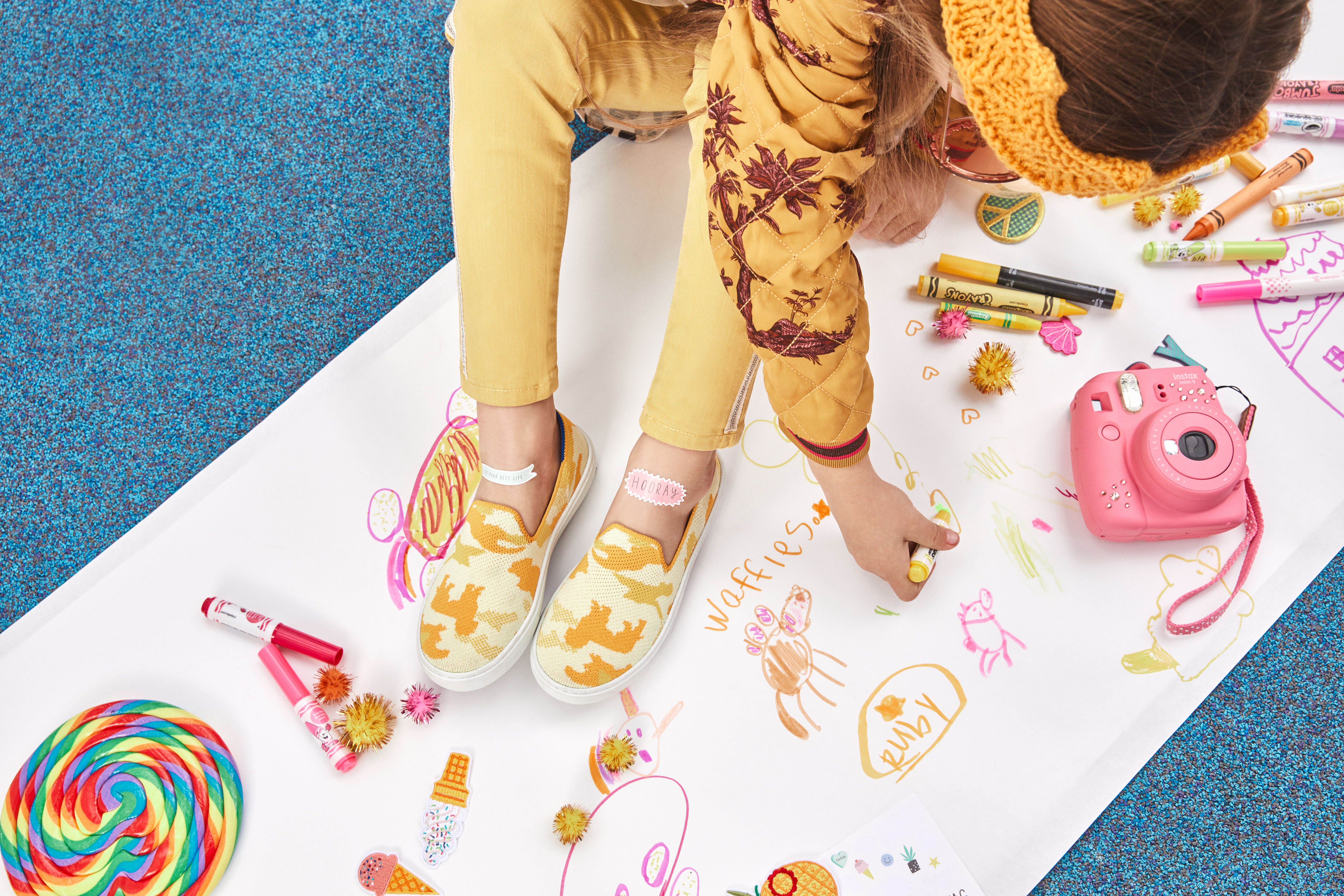
Your daughter loves her pairs of Rothy’s loafers about as much as you love your flats. Well, now your son can get in on the action with the brand-new kids’ sneaker line—which has sizes and prints for both boys and girls! Made with the same sustainable practices as the adult shoe, keep reading to discover your kids’ new favorite slip-on shoe.

The Details

Rothy’s launched a girls’ loafer line in 2018, and they’ve already achieved the same cult-favorite status of their adult counterpart, so the next step for Rothy’s was to introduce a slip-on shoe that every kid can wear. Tested out by active, busy kids, the sneakers are washable and offered in 10 different colors and prints inspired by the bright colors of the 1970s. Like all Rothy’s shoes, the sneaker has an athletic outsole, and the stretchy knit is made out of recycled water bottles.

“As a team, we loved seeing the response to our Girls’ Loafer last year. For many, the product fostered mother-daughter conversations about sustainability and recycling,” said Rothy’s Creative Director Erin Lowenberg. “When our customers started asking for a girls’ version of our sneaker we thought, why not include the whole family? The Kids’ Sneaker is a playful and gender-neutral shoe for little ones to learn about sustainability and play with happy feet—and they’re machine washable to boot!”

What’s the secret behind Rothy’s?

Rothy’s is a three-year-old company founded by Stephen Hawthornthwaite and Roth Martin, looking to re-imagine the stylish classics. They didn’t want career women to have to choose between style and comfort, so instead, they created an incredibly durable, machine-washable, flexible shoe that moves with the foot. The shoe was a hit and continues to wow.

And, they care about the process. Each shoe allows for less than 5% waste, rather than the typical 35% of materials that end up on a production floor. Rothy’s uses recycled water bottles to create their popular fabrics, and to date, they’ve repurposed over 25 million water bottles. And, each shoe is 100% recyclable: materials include recycled foam, vegan and other non-toxic adhesives and each shoe has a carbon-free rubber sole. Talk about being light on your feet.

Where to Buy Them

The brand-new sneaker line from Rothy’s is offered in sizes 10-4. Available at rothys.com, $55 a pair. If you happen to be in San Francisco, stop by the brick and mortar store located at 2448 Fillmore St. in San Francisco, CA 

—Gabby Cullen


RELATED STORIES:

Rothy’s Uber Popular Shoe Is Now Available for Girls

17 Best Kids Shoes for the Playground (& Beyond)

These Genius Shoes Are a No-Brainer Way to Get the Kids Out the Door Faster

No plans for Spring Break? No problem! A week off from school doesn’t have to lead to a case of cabin fever. Keep your kids active and engaged with one of these spring break camp. Your child’s day will be action packed,  but  act-fast before these popular camps fill up. From arts and crafts to daily b-ball drills  (and everything in between), scroll down for the best spring break camps in the DMV.

Steve & Kate's Camp

iStock

This camp is the resort of all camps. Kids get to pick their daily adventures from a roster of exhilarating activities putting THEM in charge of their camp experience. From coding and gaming to sewing and crafts, each day is filled with hands-on activities. And just like a resort, this is an all-inclusive experience. No need to pack lunch or snacks! 

When: April 11-14, 8 a.m. - 6 p.m.
Cost: $105/day
Where: Van Ness Elementary, 1150 5th St. SE
Online: steveandkatescamp.com


Camp EDCJCC April

iStock

If you need long-term coverage over spring break, check out this extended camp that has evening pick ups at 6 p.m. You can sign up for one day or enroll in all four days of fun. Each day is filled with action-packed fun like swimming, music crafts and more.

When: April 11-14, 8:30 a.m.- 6 p.m.
Cost: $125/day
Where: Edlavitch Jewish Community Center, 1529 Sixteenth St. NW,
Online: edcjcc.org

DC Way's Spring Break Soccer Camp

DC Way

Kick off spring break with this Capitol Hill soccer camp geared towards kids 5-12. Daily mini sessions (3 hrs.) are dedicated to learning a new skill designed to turn your little player into a pro. Want to send your kid off for the day? Fill their afternoon with scrimmages, fun competitions and free play at this outdoor-only camp.

When: April 11-15
Cost: $95/one day; $240/mini sessions; $395/full day (check website for additional options)
Where: Tyler Elementary School (kids 5-12), 1001 G St. SE, Capitol Hill; The RFK Fields (kids 8 & up), 401 Oklahoma Ave. NE,
Online: dcway.com

DPR Kids' Camp

iStock

Held at recreation centers in each of DC's wards, this camp run by DC"s Department of Parks and Recreation Kids is geared towards kids 3-12. Each day is filled with sports, games and arts and crafts with lessons highlighting personal growth and environmental stewardship. 

When: Apr. 11-14, 9 a.m.-5 p.m.
Cost: $40/DC Residents
Where: Jelleff Recreation Center (Ward 2), Emery Heights Community Center (Ward 4), Edgewood Recreation Center (Ward 5), Arthur Capper Recreation Center (Ward 6), Hillcrest Recreation Center (Ward 7), Therapeutic Recreation Center (Ward 7), Barry Farm Recreation Center (Ward 8), Deanwood Recreation Center (Ward 7)
Online: dpr.dc.gov

Home Run Baseball Camp

Pixabay via Pexels

Girls and boys ages 5-12 will knock it out of the park at this baseball-themed camp. This day camp is designed to get your little slugger improving their batting average FAST! Coaches here believe in repetition to build technical skills, so expect your camper to get 150 ground balls a day and over a 100 swings in batting practice! 

When: Apr. 11-15, 8:30 a.m.-2:30 p.m.
Cost: $475/session (50% off sibling discount); Half-day options are avail. for kids under 5
Where: Friendship Recreation Center, 4500 Van Ness St. NW, Friendship Heights 
Online: homerunbaseballcamp.com


All Sports & Games Spring Break Camps

Tiffany A. via Yelp

This outdoor-only camp offers boys and girls in grades 1-8 an opportunity to build on their b-ball skills with the experts from HoopED. In addition to dribbling and dunking their way through these 2 hr. clinic, they will get time to play other games on the courts (and the playground). Let your kid run off some energy while making new friends during spring break!

When: Apr. 11-15
Cost: $295/session
Where: Stuart-Hobson Middle (Capitol Hill), Murch Elementary (Friendship Heights), Lafayette Elementary (Chevy Chase)
Online: hoopeducation.com


Little Ocean Explorers

Pavel Danilyuk via Pexels

Meet new sea faring friends at this ocean-themed camp for kids 3.5-5. Hermit Crab and Rainbow Fish help kids navigate the ocean depths through hands-on activities and play-based lessons that include music, movement and props. Children will build their arts vocabulary as they interact with new characters and settings.

When: April 11-15, 9 a.m.-noon
Cost: $265
Where: 4908 Auburn Ave., Bethesda, MD
Online: imaginationstage.org


RELATED STORIES:

No Place Like Home! Top Spring Break Staycation Ideas

Kids Need Camp More Than Ever 

Is Day Camp Possible? And How do I Choose the Right One 

We survived Daylight Saving and lived to tell about it! Admittedly, much of this week was spent adjusting to longer days and the usual parent shenanigans. Keep reading for our roundup of how Twitter parents survived the last week.

1. But seriously.

2. Let the games begin!

https://twitter.com/MelissaBeagley/status/1104914823081390080

3. And that we’re both super!

4. Nope.

5. DO YOU KNOW!?

6. Is that so much to ask?

7. Everyone needs a hobby!

8. It’s going to be a long day.

9. Thank you, daylight saving.

10. Yeah, so there’s that.

––Karly Wood

photo: Ryan McGuire via Gratisography; composite by Karly Wood for Red Tricycle

RELATED STORIES

Funniest Parenting Tweets of the Week: Mar. 8, 2019

Funniest Parenting Tweets of the Week: Mar. 1, 2019

Funniest Parenting Tweets of the Week: Feb. 22, 2019

Photo: Heather Thompson

I am at a point in my life where I find myself questioning my parenting abilities daily. (To be honest, it started five years ago when my daughter was born.) But now with a five-year-old and a two-year-old, I find myself going to sleep every night filled with frustration at the way in which I handled things throughout the day. Usually, I’m in tears because I was too hard on my daughter (the five-year-old) or I resent the things I did or didn’t do with my two-year-old son.

Mom-ing is hard. It’s exhausting. It is filled with never-ending worry, battles with myself (and mini versions of myself) and constant thoughts of coulda, woulda, shoulda. And I only have two! You moms with more than two kids are my heroes. Seriously. I would die.

The last few months have been particularly trying for me. My daughter is in kindergarten and at the age where she talks all day. Literally, nonstop. It is mentally exhausting.

Then, there’s my son who does not stop moving from 6:30 am to 7:30 pm. His job on this Earth is to make messes and therefore, my job is to clean them up. As I am cleaning up one mess, he is making another. It is physically exhausting. And I’m a personal trainer! I’m used to being active! But this is a whole new level.

A few weeks ago, I was laying in bed with my husband sobbing. I was explaining all the reasons I had failed that day: I yelled way too much, I lost my patience repeatedly, I didn’t get the housework done, etc. I remember saying that I always imagined I would be a good mom—not the version I had become. I would talk things through my kids instead of yell at them, they would never eat junk food, I would play with them all the time, all the things every new mom has the intentions of doing.

Being the good husband that he is, he listened. He told me I am a good mom. Then, he told me to stop thinking about what I did wrong that day and instead, focus on what I did right. So I did. I wrote them down.

I realized that raising kids is just like any other thing in life: it is filled with ups and downs. With good and bad. So I started a list of things I did wrong (my cons) and countered it with things I did right (the pros). I decided that as long as my list broke even, I wasn’t as bad as I thought.

Sure, it would be nice if the pros exceeded the cons, but hey, mom-ing is hard. My list looked something like this:

Con: At 7 p.m., I became so tired I lost my patience and yelled at the kids during bath time. A lot.

Pro: I got up at 3:30 a.m. this morning to exercise, which put me in a great mood. I was happy and energetic when I woke them up and they were happy.

Con: My kids ate microwaved chicken nuggets for dinner and no vegetable because I just didn’t want to fight that battle.

Pro: I made them a pretty good, balanced breakfast and lunch. By good I mean it wasn’t all sugar or microwaved.

Con: They watch too much TV. Today and every day.

Pro: I do homework with my five-year-old daily and quiz her on math and spelling in the car line at school. I practiced numbers and shapes with my toddler. I mean, it was only for the two minutes he would sit still, but I tried.

Con: My two-year-old watched YouTube for an hour while I ran my business from home.

Pro: At least it was about animals so he was learning? This one might be a stretch.

Pro: Tonight, even though I lost my patience and yelled, my daughter told me I was the best mommy in the world. So maybe—just maybe—I am doing something right.

The purpose of my list was to change my focus. To stop concentrating on the bad and start remembering the good. I don’t want to ignore my cons because those are the things I need to work on, but I need to remember the pros, too.

I am not a bad mom. I am a mom trying to figure it out.

I am trying to get through the days and raise good humans. Sure, they watch too much television, eat too much sugar and throw temper tantrums. But on the other hand, they are extremely smart, considerate, funny and strong-willed. They aren’t perfect, but neither am I.

We all have our lists. I can’t cook, but I can clean. I don’t like to play Barbies, but I am always in for a board game or book. I am not crafty, but I can find anything online. I am not the best mom, but I sure do love my kids.

When you are having a bad day, try making your list. Automatically, you will find the cons, but really make an effort to find those pros. They are there. And if you can’t find them, ask your kids. They will tell you—because even when you think you are doing everything wrong, they think you are doing so much right.

I am a fire wife, a mom of two (ages 5 and 2  and a business owner. I am passionate about fitness, help and helping others. I feel like lifting weights and writing are both free forms of therapy.